America Outsourced Everything (Except the Laundry)
Hey folks, Jesse here 👋 — America’s being wildly delegational again this week, so I dug in, snorted some data dust, and came back with the goods. Let’s go.
🕵️ Uncle Sam Deputizes the Nerds
The federal government just deputized private companies to hack back at foreign criminals — surveillance, sabotage, the works — because apparently the actual government agencies built for this were suddenly too busy.
On August 12, President Trump signed a memorandum letting vetted private firms run offensive cyber operations, including surveillance and system-destroying attacks, against foreign criminal hacking networks — a power historically reserved for the NSA and Cyber Command.
For decades the federal rule was simple: defend, don’t attack. Now Washington is handing out permission slips for revenge hacking, provided companies post at least $1 million in escrow and promise not to accidentally flatten a hospital’s servers in the crossfire. Nothing says measured statecraft like crowdsourcing cyberwarfare to whoever can afford the deposit.
Cybersecurity veterans have already flagged the catch: Americans doing this work abroad could be treated as “non-uniformed combatants” by the very governments they’re targeting, meaning your local infosec contractor might now moonlight as an international incident waiting to happen.
“We built an entire Bureau of Investigation so citizens wouldn’t have to freelance justice. Now we’re paying private contractors to do it anyway, laptop instead of badge.”
- 💡 Companies must post at least $1 million in escrow before launching an operation (WaPo)
- 📊 Americans reported losing more than $20.8 billion to cyber-enabled crime in 2025 (WaPo)
- 🧠 The policy marks the first time private firms have been authorized for offensive, government-sponsored hacking (WaPo)
Source: The Washington Post — “Trump signs memo authorizing private sector to launch cyberattacks” (https://www.washingtonpost.com/national-security/2026/08/14/trump-signs-memo-authorizing-private-sector-launch-cyberattacks/)
📉 Consumers Just Ghosted the Economy
Retail sales just posted their steepest monthly drop in over a year, and consumer sentiment cratered right alongside it — proof that Americans are tapping out of the economy at the exact same time.
U.S. retail sales fell 0.6% in July, the steepest decline since May 2025, while the University of Michigan’s consumer sentiment index sank to a preliminary 51, down from 55.2, ending two straight months of improving mood.
Economists point to fading tax-refund spending and Amazon shifting Prime Day earlier in the calendar. Sure. But paying well over $4 a gallon for gas while inflation still runs above target will do that to a nation’s spending mojo regardless of what the spreadsheet says caused it.
The silver lining, if you squint hard: soft numbers make a September rate hike less likely. Congratulations, America — you’re sad and broke enough to earn the Federal Reserve’s sympathy.
“Nothing says economic confidence like celebrating that we’re too broke and bummed out for the Fed to raise rates.”
- 💡 Retail sales fell 0.6% in July, to $763.6 billion (Reuters)
- 📊 Consumer sentiment dropped about 8%, to a preliminary reading of 51 (Reuters)
- 🧠 Sentiment fell hardest among Republican-identifying respondents, a possible midterm warning sign (Reuters)
Source: Reuters — “US retail sales post first decline in nine months in July” (https://www.reuters.com/business/us-retail-sales-unexpectedly-fall-july-2026-08-14/)
🦾 Zuckerberg’s Pitch: Your Own Superintelligent Lawyer
Mark Zuckerberg wrote a 6,500-word manifesto promising every American a free personal AI genius — a tutor, a coach, even a lawyer — and critics immediately asked where exactly the receipts were.
On August 10, Zuckerberg published an essay titled “The Future Is for Everyone,” arguing that letting Meta build AI without heavy restrictions is the safest path forward because it distributes power to individuals instead of concentrating it in a handful of labs.
It’s a lovely pitch from the company that once promised us the metaverse and delivered leg-less avatars in a conference room. The essay lands as the American public grows more wary of AI, politicians across the spectrum push for regulation, and even rival AI companies are floating the idea that the industry should slow down.
That context matters more than the manifesto’s language. A company betting hundreds of billions on AI infrastructure has every incentive to frame “trust us, unrestricted” as a public good rather than a business plan.
“Every tech founder wants to hand you superintelligence right after spending a decade fine-tuning the algorithm that keeps you doomscrolling at 1 a.m.”
- 💡 The essay ran roughly 6,500 words and was published August 10 (WaPo)
- 📊 American public sentiment toward AI is described as increasingly hostile (WaPo)
- 🧠 Politicians across the political spectrum are now pushing to regulate the technology (WaPo)
Source: The Washington Post — “Zuckerberg’s manifesto says Meta’s AI will make a ‘future for everyone'” (https://www.washingtonpost.com/technology/2026/08/10/zuckerberg-manifesto-says-meta-ai-will-make-future-everyone/)
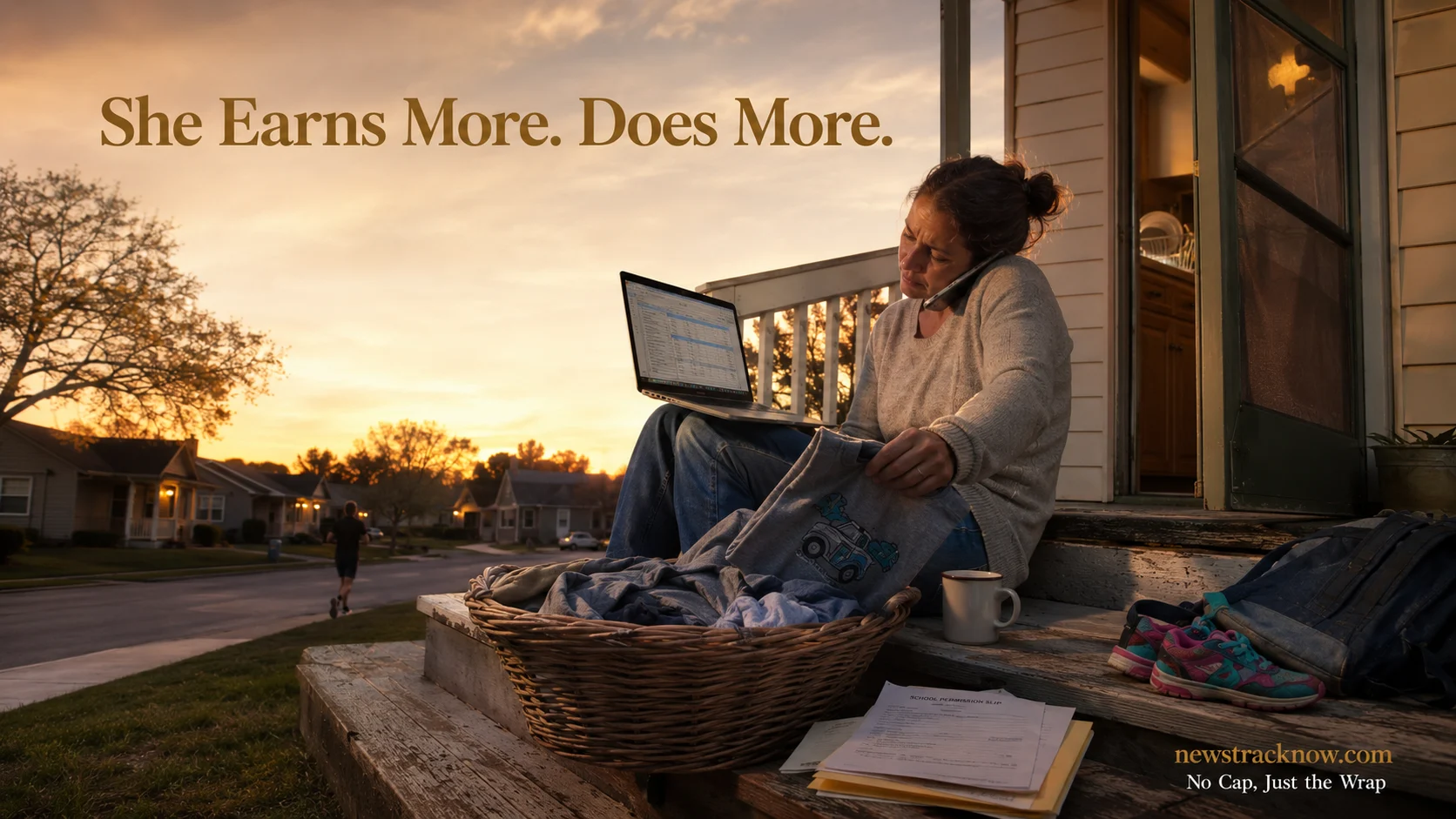
💸 She’s Winning the Bread. She’s Also Baking It.
More women than ever are out-earning their partners, and yet the same online discourse keeps circling back to one uncomfortable pattern: they’re still doing basically everything else at home too.
NPR’s “All Things Considered” dug into a wave of discourse about heterosexual relationships in which women carry the financial load and the invisible one — the scheduling, the cleaning, the parenting logistics — even as their paychecks grow.
We keep telling women that out-earning your partner is the finish line for equality. Turns out it’s more like a second job with better direct deposit. Financial journalist Hanna Horvath, cited in the segment, pointed to research finding that female breadwinners still do more cooking and cleaning than their partners — while husbands gained extra hours of leisure time each week.
This isn’t a “just hustle harder” problem. Nobody renegotiated the chore chart when the paycheck flipped.
“We didn’t close the gender gap. We just moved it from the office into the kitchen and called it progress.”
- 💡 A cited 2025 study found female breadwinners still do more cooking and cleaning than their partners (NPR)
- 📊 In these households, husbands gained roughly nine additional hours of leisure per week (NPR)
- 🧠 Pew data cited in the discussion shows primary-earner wives also take on more caregiving (NPR)
Source: NPR — “What the data says about the discourse around men, women and money” (https://www.npr.org/2026/08/13/nx-s1-5929561/what-the-data-says-about-the-discourse-around-men-women-and-money)
🤧 COVID’s Back for Its Annual Summer Cameo
COVID-19 has quietly kicked off its now-annual summer surge again, and almost nobody noticed because the news cycle has been busy panicking about hantavirus, lettuce recalls, and everything else instead.
NPR reports the U.S. is in the middle of its predictable summer COVID wave, with cases and wastewater virus levels climbing fastest in the South and West, while the Northeast and Midwest start catching up too.
Between hantavirus headlines, a lettuce-linked outbreak, and general summer chaos, COVID has become the ex who still texts every July — not dramatic, not gone, just quietly there in the group chat of American anxieties.
The actual good news: infectious disease experts say this wave looks milder than prior years, likely thanks to accumulated immunity from past infections and vaccination, meaning fewer hospitalizations even as case counts tick up.
“We didn’t beat COVID. We just got bored of covering it, and it took the opportunity to come back every July like clockwork.”
- 💡 COVID activity is rising fastest in the South and West, with other regions following (NPR)
- 📊 This summer’s wave is trending milder, continuing a pattern of fewer hospitalizations each year (NPR)
- 🧠 Experts credit growing population immunity from repeat infections and vaccination (NPR)
Source: NPR — “Is there a summer COVID-19 surge this year? Yep, it’s ramping up again” (https://www.npr.org/2026/08/14/nx-s1-5927115/summer-vaccine-covid-19-surge)
(A quick note: this is general health reporting, not medical advice — if you’re at higher risk or feeling unwell, a doctor is a better source than a newsletter.)
🎰 Wall Street’s Newest Bet: What Trump Says Next
Federal regulators are now investigating whether it’s legal to bet millions of dollars on the exact words a public figure might say — and yes, a presidential teleprompter operator is involved.
Prediction markets like Kalshi run so-called “mention markets,” where bettors wager on whether a speaker — from the president to sportscasters — will utter a specific word. The CFTC opened a probe after Trump’s own longtime teleprompter operator was caught profiting from suspiciously well-timed bets on the president’s phrasing.
We’ve apparently built a financial instrument around insider knowledge of a teleprompter feed. That’s not a stock tip, that’s a job description. Somewhere, a hedge fund manager is furious he didn’t think to bug a podium first.
Even regulators concede these markets are “not popular across the political aisle” — rare bipartisan agreement that betting on syntax might be a scam with extra steps.
“We regulated insider trading on stocks for a century, and it took exactly one teleprompter operator to remind everyone that words are an asset class now too.”
- 💡 The CFTC opened its probe after Trump’s teleprompter operator profited from mention-market bets (NPR)
- 📊 Kalshi’s own surveillance tools flagged the suspiciously well-timed trades before reporting them (NPR)
- 🧠 Most prediction markets are only “self-certified,” not pre-approved by federal regulators (NPR)
Source: NPR — “Feds probe ‘mention markets’ amid White House Kalshi controversy” (https://www.npr.org/2026/08/13/nx-s1-5930689/cftc-probe-mention-markets-prediction-markets-kalshi)
That’s a wrap for this week, friends. Keep your coffee strong, your mind curious, and your browser tabs weird.
— Jesse Blaze
Real talk: if you’re the higher earner in your relationship, did the chores actually renegotiate, or did they just relocate? Reply and tell me — I’m collecting receipts.